

Looking for the best trees for Central Texas? Austin and surrounding area have no shortage of great trees but we are challenged with a lack of diversity. When more people use a wealth of native and adapted trees that home, feed and sustainably support our local insect and animal population, we’re improving our ecosystem for all.


Mother Tree
Trees improve our quality of life by providing shade and fresh air, they lower our energy costs, water usage (once established) and provide food and flower. With an abundance of blessings, it is each and every one of our responsibilities to plant trees wherever we can. Here are some of my favorites!
Edible Trees

Kieffer Pear
This is a great selection for Central Texas and it provides hundreds of fruit each year and reaches to 25-30’. Stunning fall color, low water and fire blight resistant.

June Gold Peach
Many in Central Texas are familiar with Fredericksburg peaches, but you might not realize you can also grow your own. With several varieties of peach, apple, pear, plum, persimmon, loquat, fig, pomegranate and pecans. You could have your very own orchard. Fruit trees take no more water than others but they do require training/trimming for best results. Comparatively short lived at 20 years, they can provide many good years of free food!

Wonderful Pomegranate
In conclusion, fruit trees need to be for your Hardiness Zone, we need to plant them properly and feed them with rich compost and the rewards are bountiful. However, if you already have a yard full of squirrels you could be planting a buffet, so here are some more options…
Fragrant and Flowering Trees
Many trees native to Central Texas produce fragrant flowers, a variety of berries, fall leaves and seasonal color. Here are some of my favorite, fragrant blooming trees.

Anacacho Orchid
(above) is a small semi evergreen flowering tree that’s extremely fragrant and unique in both its shape and leaf structure. Deer resistant and low water, it’s a beautiful specimen tree that matures to 10 x 8’ or smaller. The Texas Mountain Laurel (below) possesses the same qualities but is evergreen and grows to 25 feet at an extremely slow rate. I don’t recommend this plant for privacy because it is a slow baby, but it’s a beautiful specimen worth waiting for. Both trees do well from full sun to part shade.

Mountain Laurel
Mexican or Texas Redbud
The Mexican or Texas Redbud tree is a medium sized tree that can also be an excellent understory tree. Sporting purple/pink flowers ever spring followed by bright green scalloped leaves all summer and yellow fall color.

Redbud Tree
Desert Willow

Desert Willow Tree
Above is the “Bubba” Desert Willow which is a full sun, deciduous tree with a true Willow form. With its long narrow leaves and stunning mauve/pink, fragrant blooms, it’s easy to see why this tree should be included in your xeriscape landscape.
Another true love of mine is the Texas Kidneywood or Bee Bush. Another low maintenance tree reaching to 6-8’x12’ and performs well from sun to shade. It’s low water once established (sensing a theme?), deciduous and deer resistant. Flowering in cycles over the summer, this super fragrant tree can be experienced all over your space.

Kidneywood Tree
Mexican Plum

Mexican Plum Tree
On the fun list of funky native Texas trees is Mexican Plum (above), which many notice in late winter/early spring for their white flowers and again in summer when they produce small tart plums that while edible, I don’t find them all that great but the critters love them.
Speaking of funky, below is the Royal Purple Smoke Tree. This shrubby tree is a beautiful specimen tree that takes full sun and blooms wispy puffs of tiny pink flowers that look like smoke raising from the leaves. 10×10-12 at maturity, little to no maintenance.

Purple Smoke Tree
Goldenball Leadtree
Goldenball Leadtree (below) is right out of a kids book with its yellow fuzz ball flowers. Both trees are super low water, and deer resistant and have interesting bark or leaf structure that makes them stand out in the landscape.

Goldenball Leadtree
Mexican Buckeye

Mexican Buckeye
Mexican Buckeye (above) is a small flowering tree that thrives in sun to part shade and blooms every spring with roses pink flowers that are followed by funky seed pods and Little Gem Magnolia, or Southern Magnolia (below) is a dwarf specimen that reaches to 20’ tall and 10’ wide instead of the typical “yard eaters” many folks are used to. Requiring little to no maintenance once established, which makes these huge fragrant blooms worth a try. Leaves also make beautiful dried arrangements.

Little Gem Magnolia
Interesting Bark, Berries, Leaves and Fall Color

Lacebark Elm
A beautiful tree with elegant bark and interesting leaf structure. Choosing a variety of native and adapted trees is not only more beautiful, but the diversity is crucial to the local fauna whose homes and wild space are shrinking.

Possumhaw Holly
Possumhaw Holly (covered in berries all winter) and Yaupon Holly Trees like Pride of Houston and Scarlets peak, make beautiful specimen and privacy trees that are evergreen and deer resistant. They’re also very low water and low maintenance.
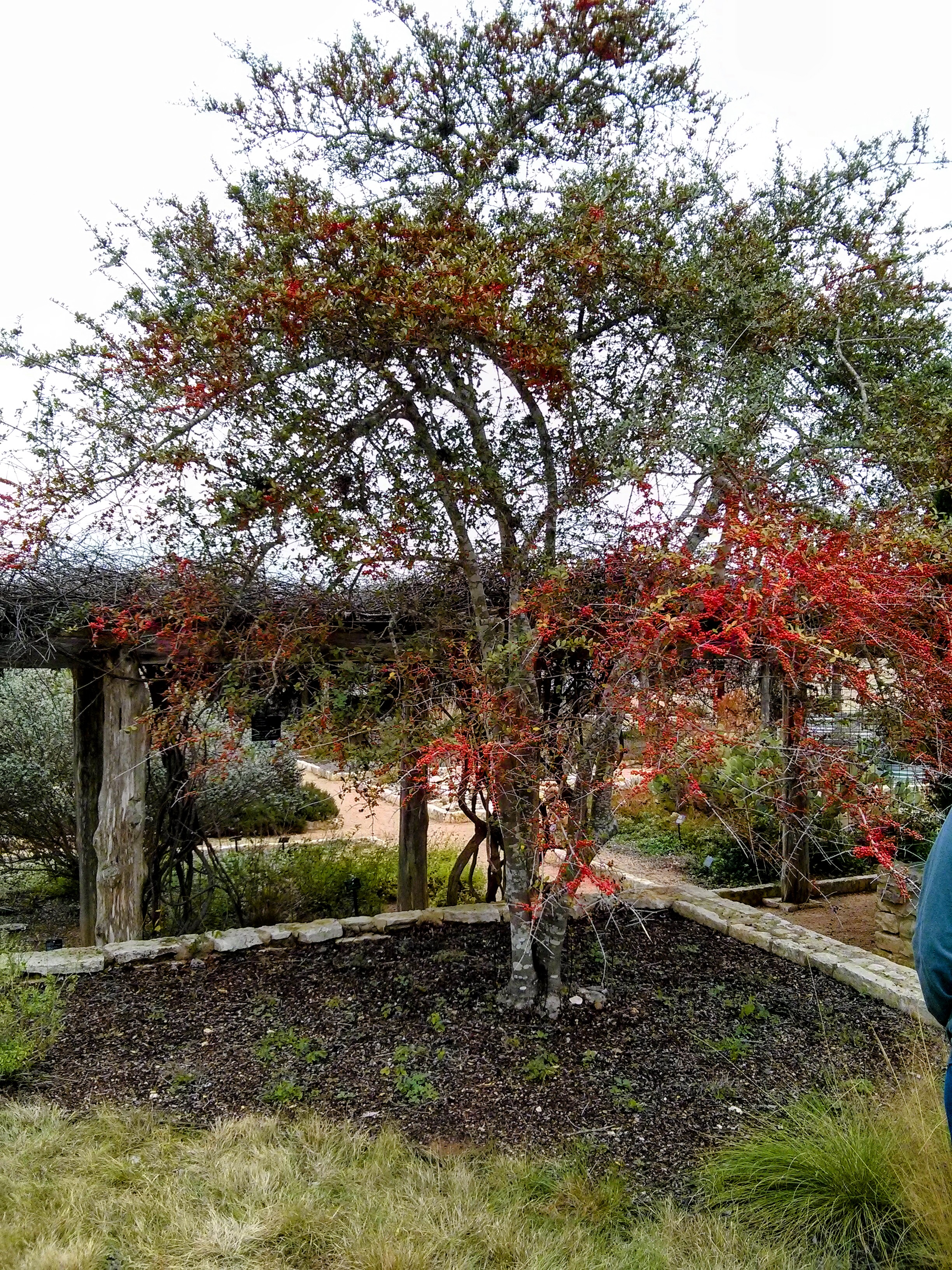
Possumhaw Holly
Mexican Sycamore
Trees with interesting leaves like the Mexican Sycamore (below) create movement and shade. Hardwood trees like Chinquapin Oaks, Monterey Oaks or Burr Oak are great alternatives to the 2.5 live oaks in every yard because they have unique leaves and acorns as well.

Mexican Sycamore
Carolina Buckthorn
Carolina Buckthorn is a medium sized tree with bright leaves and purple, edible berries in the fall. Growing to 15-25’ this no maintenance tree will be a great way to hide your neighbors or just enhance the view.

Carolina Buckthorn
Plant for Fall Color
Fall leaves are a seasonal gift that carries the landscape well into winter. Look for varieties of trees that are evergreen, flowering and deciduous for interest all year.

Leave Plenty of Room For Maturity
A mature tree can take up a lot of real estate so plan ahead, keep trees away from sidewalk, driveways and rooflines, and remember the best time to plant trees in Central Texas is over the winter months.

Use Proper Planting and Watering Techniques

Make sure newly planted and mature trees are not over buried with mulch, dirt or grass.
Practice Proper Mulching Methods

This is wrong…

This is right…

If you’re anywhere in the Central Texas or Hardiness zone 8 a/b and would like some help with your landscape, contact me for an Educational Consultation for even more great plant and tree selections.
Now go get your tree gardening on!
Lisa LaPaso
Lisa’s Landscape and Design
”Saving the Planet One Yard at a Time”